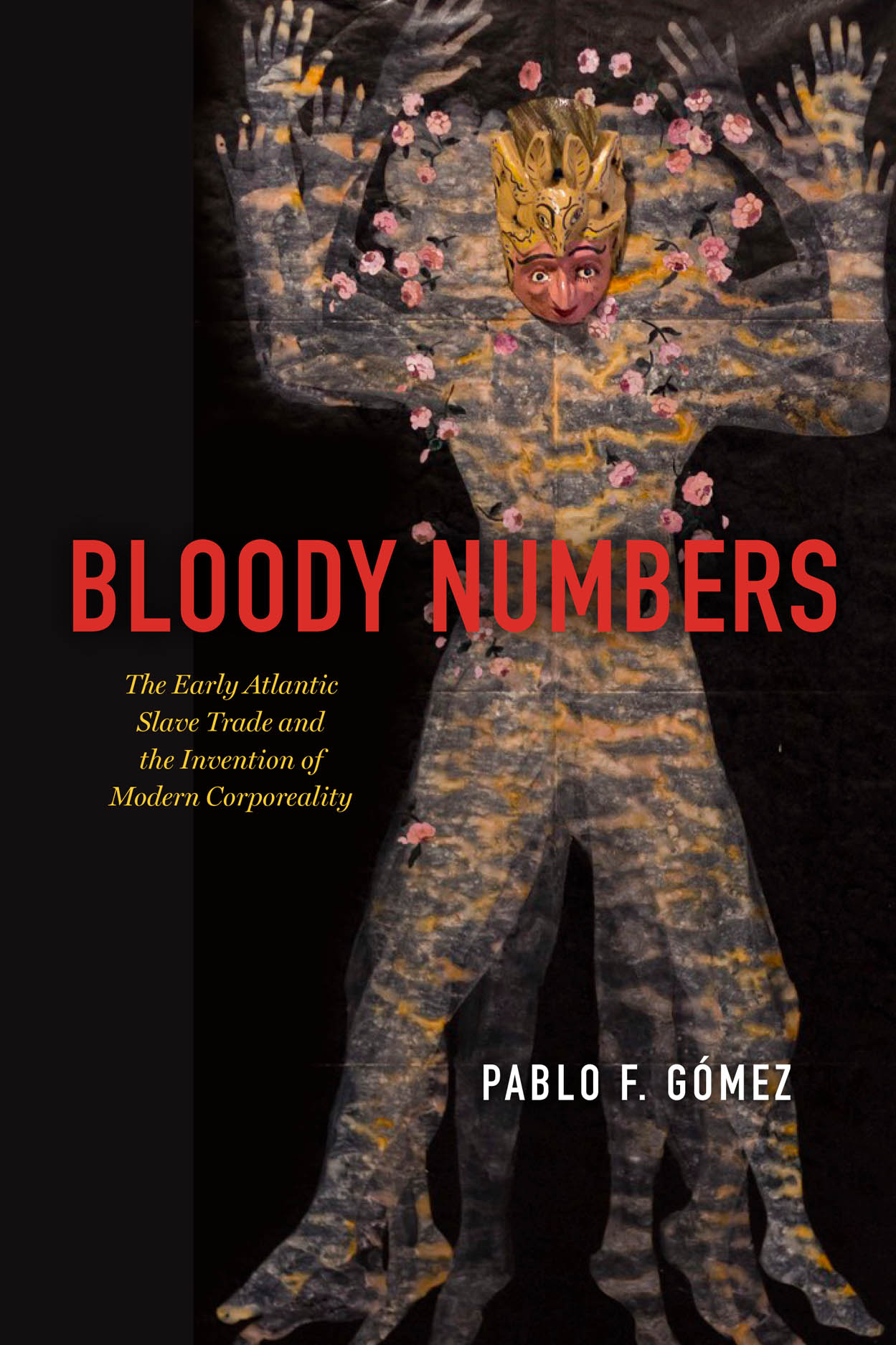
Bloody Numbers

The Early Atlantic Slave Trade and the Invention of Modern Corporeality

Bloody Numbers

The Early Atlantic Slave Trade and the Invention of Modern Corporeality

Upends current thinking about how early modern people started to conceptualize human beings in terms of populations.
 
Bloody Numbers is a provocative account of the violent world of the sixteenth and early seventeenth-century South Atlantic slave-trading societies, where traders, officials, notaries, and ship captains began thinking about human bodies as aggregate populations understood through numbers: measurements, averages, and calculations of risk and value assessed through the tabulation of heights, weights, tumors, scars, and other characteristics. Pablo F. Gómez explores how figures within the Spanish, Portuguese, and African slave trades used this model for understanding human bodies to generalize about behavior and disease in ways that foreshadowed the work of modern epidemiologists and public health officials—though they employed their probabilities with the brutal aim of protecting their financial interests rather than caring for enslaved people. The ruthlessness inherent in these practices became ingrained in the modern corporeal mathematics that emerged from the early slave trade and diffused through its vast political, financial, logistical, and intellectual networks.
 
A pathbreaking work, Body Numbers reveals the historical actions that rendered populations quantifiable. In doing so, Gómez shows that confronting these origins is essential to understanding the violent political, legal, economic, and scientific practices that ascribe numbers to our own bodies.

288 pages | 13 halftones, 4 tables | 6 x 9 | © 2026

History of Science

Latin American Studies

Medicine

Reviews

“A passionate and precisely delineated history of our world. Gómez’s remarkable excavation reveals a world from which the quantitative evaluation of human bodies emerged, a foundation for all forms of biomedicine. Forged in the mercantilist violence of the early Iberian Atlantic, the evaluations of corporeal substance performed on enslaved persons turned them into decontextualized, composite physical peças (pieces). He concludes that ‘the swarm of ciphers that arose in their wake holds the meaning of our flesh.’ Not to be missed.”

Harold J. Cook, author of “The Young Descartes: Nobility, Rumor, and War”

“Gómez’s new book is a work of extraordinary scholarship. It is also a revelation. For generations, scholars have placed the origins of modern, rational systems of quantifying people in Enlightenment traditions of political arithmetic and public reform. But there is an earlier, more troubling history to reckon with. This book shows how the practices of aggregating individuals, creating universalizing measures, and making quantified predictions of health and mortality emerged out of medieval European and African mercantile or slave-trading practices, scaled up to meet the needs of a large pan-European investor class, as well as growing Iberian imperial bureaucracies. These quantifying achievements obscured, justified, and amplified the violence and dehumanization inherent to the trade of humans across oceans and the exploitation of enslaved labor in dangerous work. Bloody Numbers is a must-read for historians of science and everyone who thinks about the role of quantification in societies around the world.”

Dan Bouk, author of “Democracy’s Data: The Hidden Stories in the US Census and How to Read Them”

Table of Contents

A Note on Sources and Terminology

Introduction
1. Slave-Trading Communities
2. Accounts
3. Armazones and Piezas
4. A World of Facts
5. Procedure
6. Probabilities
Coda

Acknowledgments
Notes
Bibliography
Index

Be the first to know

Get the latest updates on new releases, special offers, and media highlights when you subscribe to our email lists!

Sign up here for updates about the Press