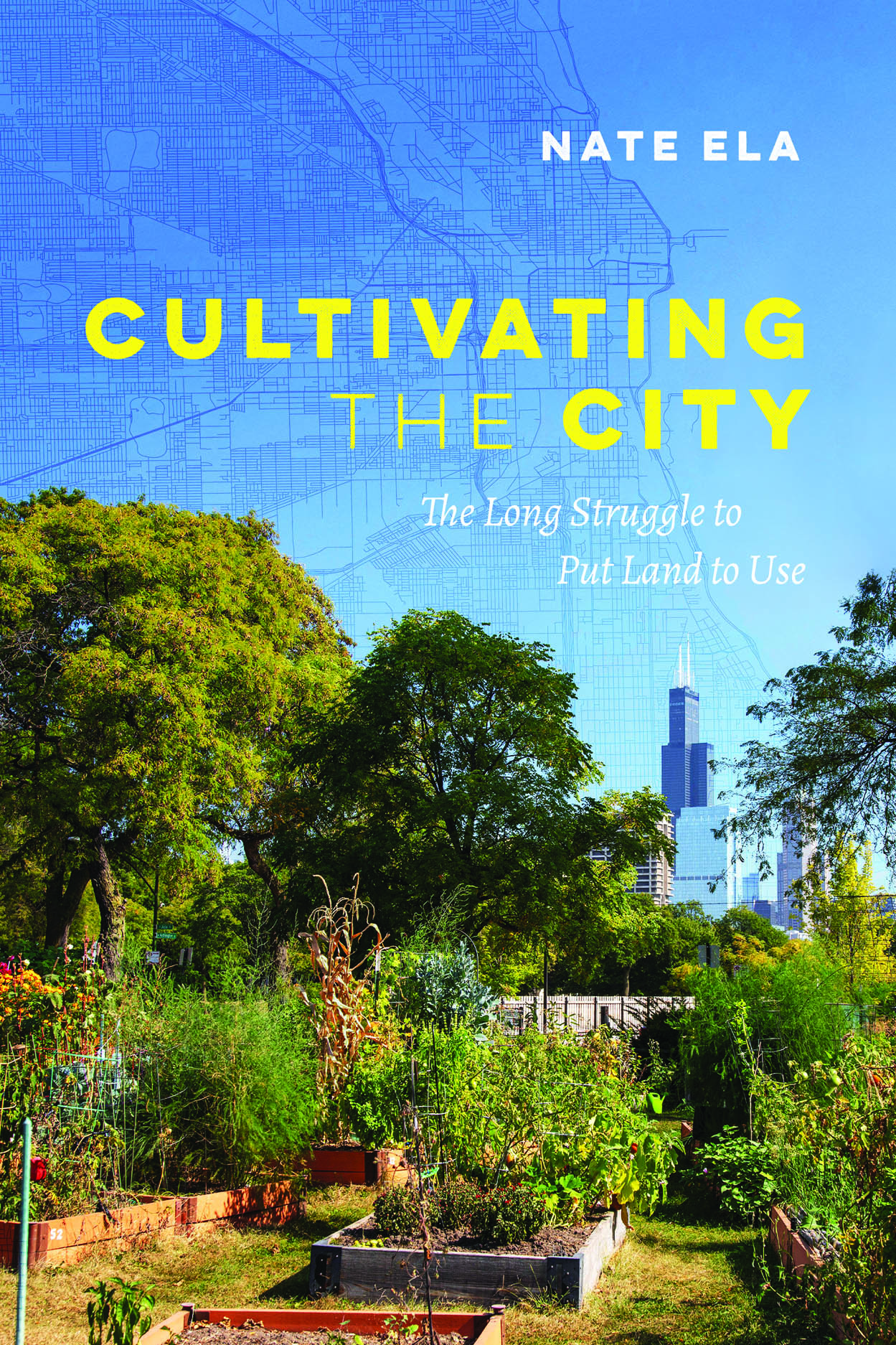
Cultivating the City
The Long Struggle to Put Land to Use
Cultivating the City
The Long Struggle to Put Land to Use
A story of law and social policy in a place you might not expect: community gardens and urban farms.
Though Chicago is a city of legendary skyscrapers and dense apartment blocks, it is also a city of wide-open tracts of land. This surprising juxtaposition can be viewed as an opportunity, in that available land can become a food source for urban dwellers, especially those experiencing poverty or limited access to grocery stores. But most empty land in Chicago remains empty — why? In Cultivating the City, sociologist and legal scholar Nate Ela examines the history of Chicago’s urban farms and gardens, their promotion as a tool to support the poor and unemployed, and their repeated failure to take root as a permanent part of Chicago’s landscape.
Ela’s fresh take on contemporary urban agriculture features a new perspective on social policy and urban governance. For hundreds of years, social reformers have worked to address poverty and unemployment by letting people use land to grow food. Reformers experimented with the possibilities of property use, including deals to match gardeners with public or private land, proposals to let growers use land without owners’ permission, and the transformation of private land into municipal gardens. By exposing the dynamics of this longstanding but long-overlooked form of social policy in Chicago, Ela offers a new strategy for cultivating cities that are productive, resilient, and just.
336 pages | 18 halftones, 1 tables | 6 x 9 | © 2027
Geography: Urban Geography
Law and Legal Studies: Law and Society
Sociology: Social Change, Social Movements, Political Sociology, Social History, Urban and Rural Sociology
Reviews

Table of Contents
Preface: Solving the Problem of Existence
Introduction: Land Use as Social Policy
Part 1
1. Reclaim the Commons
2. Envision a City Transformed
3. Move People to Use Land
Interlude: A City Remade
Part 2
4. Cultivate Shared Use
5. Trust Land to Provide
6. Reinvent the Farm
7. Free Lands, Free People
8. Use Property to Build Power
Conclusion: How to Make a City Flourish
Acknowledgments
Appendix: Studying a Recurring Social Problem
Notes
References
Index