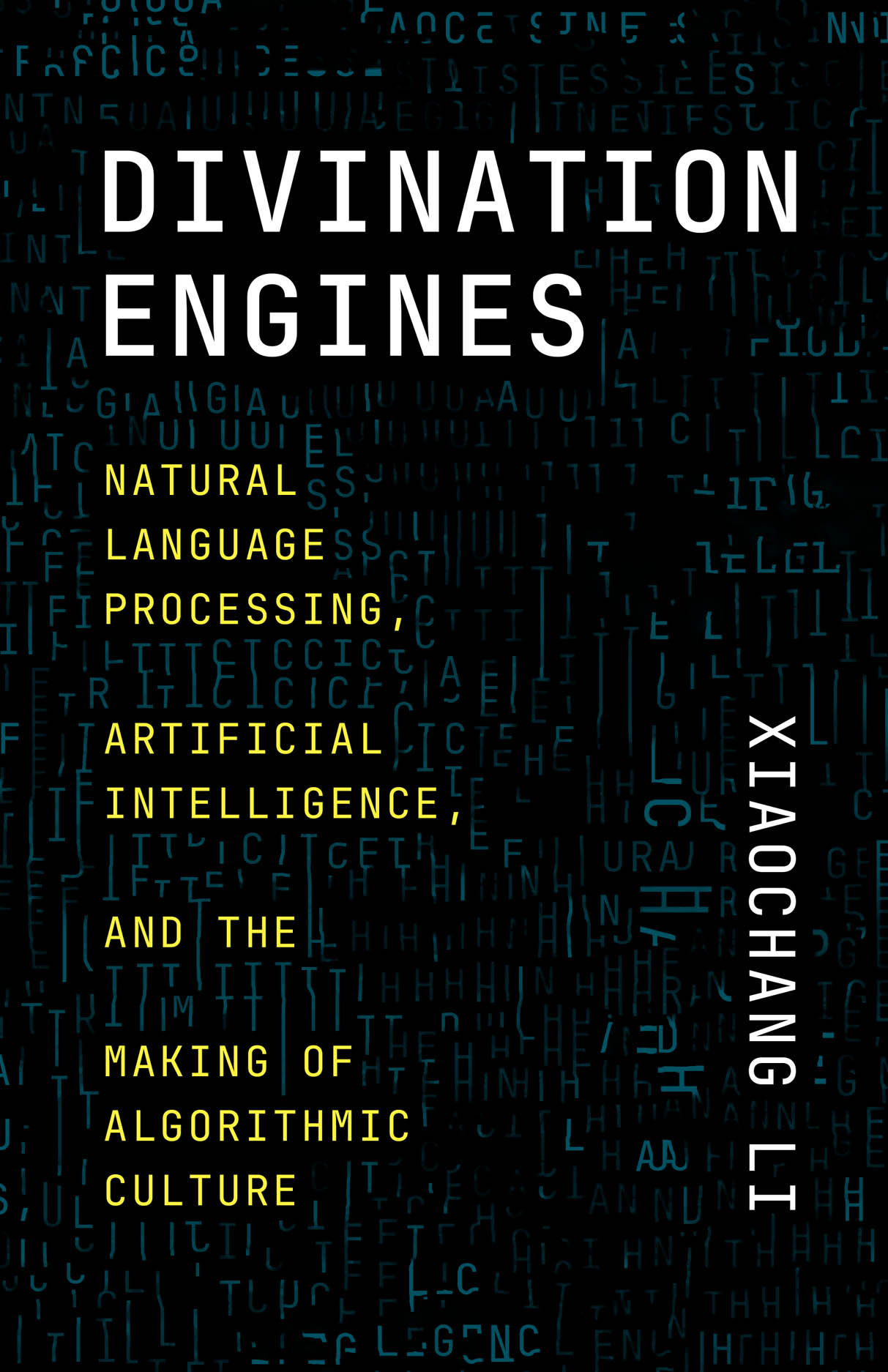
Divination Engines
Natural Language Processing, Artificial Intelligence, and the Making of Algorithmic Culture
Divination Engines
Natural Language Processing, Artificial Intelligence, and the Making of Algorithmic Culture
A revealing and surprising origin story, showing how attempts to render human speech and language computable led from the era of big data to today’s AI.
Since the advent of computers, society has fantasized about conversing with machines. In this eye-opening book, technology expert Xiaochang Li shows readers how that dream both fueled the demand for data and set the stage for today’s generative AI. With original research and clear explanations, Li elucidates the origins of what’s known as natural language processing (NLP) and the heated twentieth-century debates between computer scientists, linguists, and communication engineers that shaped today’s technology. Starting with early devices that recorded, analyzed, and attempted to interpret human speech, she demonstrates how computer speech recognition, particularly efforts led by Bell Labs and IBM, advanced technology by deemphasizing linguistic meaning in favor of statistical prediction. In other words, researchers gradually abandoned systems that sought to understand human language, opting instead for work-arounds that simply predicted patterns in speech and text data. That solution became incredibly and surprisingly adaptable. As Li reveals, transforming linguistic questions into engineering ones ushered in the routine operation of search engines, spam filters, and the varied content sorting and recommendation mechanisms that regulate the access, circulation, and legitimacy of information across every platform. But this has all come at the cost of forever requiring copious and ever-growing amounts of new data.
At its core, Divination Engines illuminates how the artifacts of human communication—speech, text, and images—have become both the fodder for and products of computers. This connection between communication and computation, Li shows, has given rise to data-driven analytics, machine learning, and today’s algorithmic culture.
320 pages | 24 halftones | 5 1/2 x 8 1/2 | © 2026
Language and Linguistics: General Language and Linguistics
Reviews

Table of Contents
Chapter 1. Introduction: Language Problems
Chapter 2. The Meaning-Measurement Relation
Chapter 3. An Artful Deceit
Chapter 4. The Model of Ignorance
Chapter 5. A Proximate Knowledge
Chapter 6. The Crude Force of Computers
Chapter 7. Data’s Rising Tide
Conclusion. Beyond Recognition
Acknowledgments
Notes
Bibliography
Index