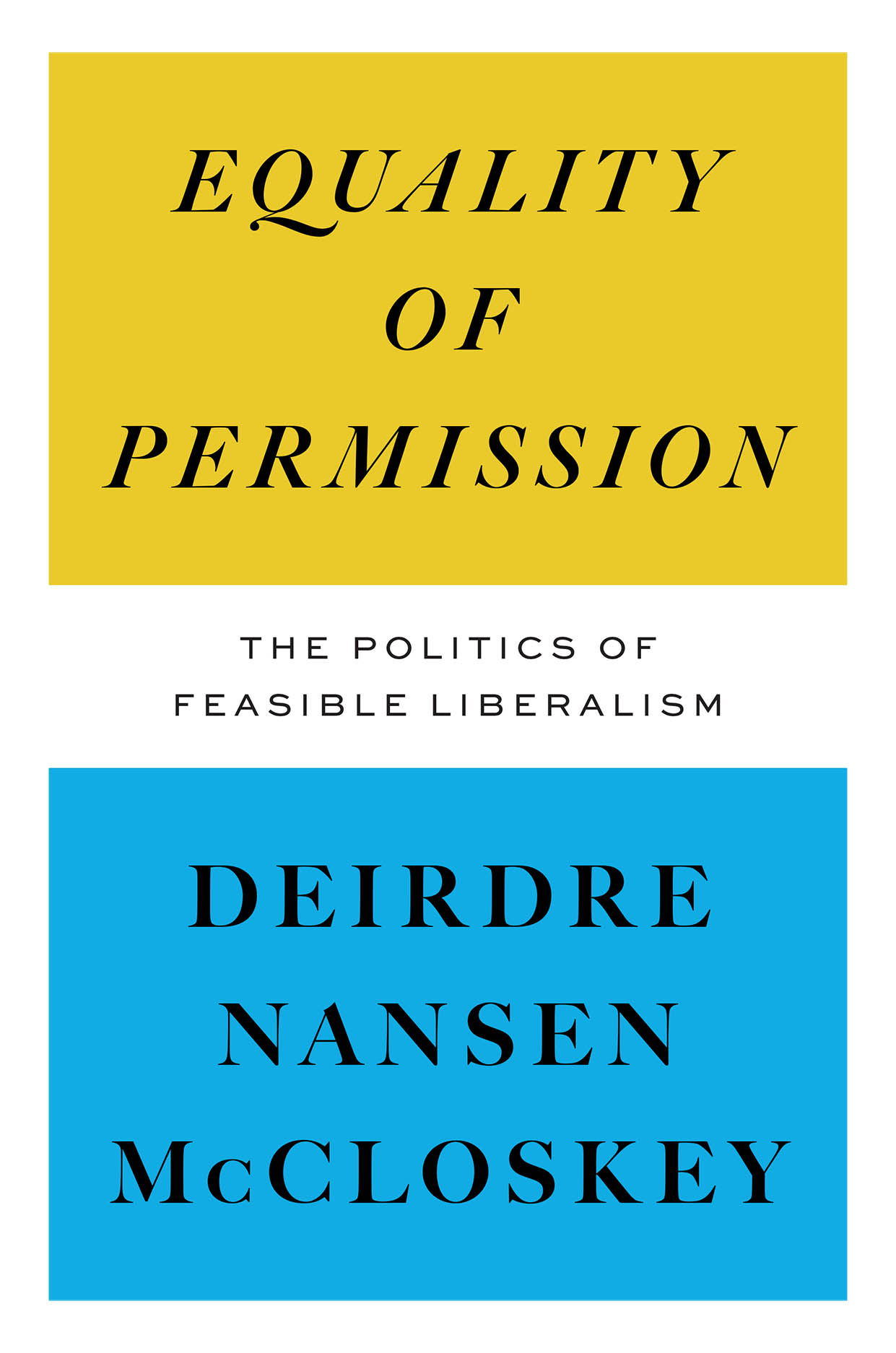
Equality of Permission
The Politics of Feasible Liberalism
Equality of Permission
The Politics of Feasible Liberalism
From a revered public intellectual, an essential argument for the political preconditions of a liberal society.
Liberalism has always suffered from messaging challenges. It simultaneously implies a pursuit of individual liberty and social equality, two projects often regarded as at odds. Or: Liberal means the opposite of conservative. Except when it doesn’t. The list goes on.
Liberal bard Deirdre Nansen McCloskey understands these rhetorical troubles. Equality of Permission is her stirring and career-defining intervention on this essentially contested yet critical topic—a forceful case for liberalism as our best hope, and an essential vision of the political conditions necessary for its survival. McCloskey prescribes a liberalism built around liberty from the bottom up: “equality before the law and equality of political and economic permissions,” lightly administered.
The state, McCloskey argues, is increasingly the source of our discontents—an illiberal institution, hindered by a quixotic fixation on pursuing equality of wealth or opportunity. Equality of Permission evangelizes for a better, and earlier, version of liberalism—that of John Locke, Adam Smith, Mary Wollstonecraft, and Henry David Thoreau—as against a top-down quest for an unattainable utopia. McCloskey shows that statism in pursuit of a chimerical general will, even when well-intentioned, leads to tyranny.
Brimming with energy and erudition, drawing on wisdoms from Alexis de Tocqueville to Mae West, Equality of Permission is McCloskey at the peak of her powers—brilliant, lacerating, garrulous, funny, worldly, and warm. Amid intense debate over the use and abuse of government institutions, McCloskey shares her singular vision for a true democracy, one grounded in respect and conducive to universal human flourishing.
312 pages | 2 line drawings | 6 x 9 | © 2026
Economics and Business: Economics--General Theory and Principles
Political Science: Classic Political Thought
Reviews

Table of Contents
Part I: Primary Liberalism Is Plausible
1. A Materialist Statism Prevails
2. Primary Liberalism Is Unpopular
3. A Statist Can Reform
4. Statism Doesn’t Work
5. Primary Liberalism Does Work
6. Both Equalities of Outcome and of Opportunity Are Impractical
7. Statism Depends on Illiberal Myths
8. “A Man’s a Man for a’ That” Suffices
9. Primary Liberalism Is Adult, Though Boring
10. Primary-Liberal Persuasion Is Not Coercive or Dominating
11. Liberty Is Liberty Is Liberty, the Opposite of Physical Coercion
Part II: Statists Are Careless of Primary Liberalism and of Historical Facts and Economic Logics
Progressive Economists
12. They Believe That Flourishing Requires More Coercion
13. More and More Coercion
14. Behavioral Economics Coerces
15. Most Economists Imagine Externalities and More Coercions to Offset Them
High Liberal Progressives
16. What Communitarians Can’t Buy
17. The High Liberals Ignore Historical Facts and Economic Logics
Conservatives
18. Catholic Conservatism Fails
19. Conservatives, Like Most Marxists, Also Ignore Historical Facts and Economic Logics
Part III: Facts, Logics, and Ethics Imply Primary Liberalism
20. The Historical Facts and Economic Logics Imply That an Ethical Revaluation, Not Exploitation or Accumulation, Caused the Modern World
21. Therefore the Seven Virtues Are Foundational to Primary Liberalism
22. And the Nussbaum Lemma Undermines One-Virtue Politics
23. Neither Statism nor Anarchism but Primary Liberalism Rules
Acknowledgments
Notes
Works Cited
Index