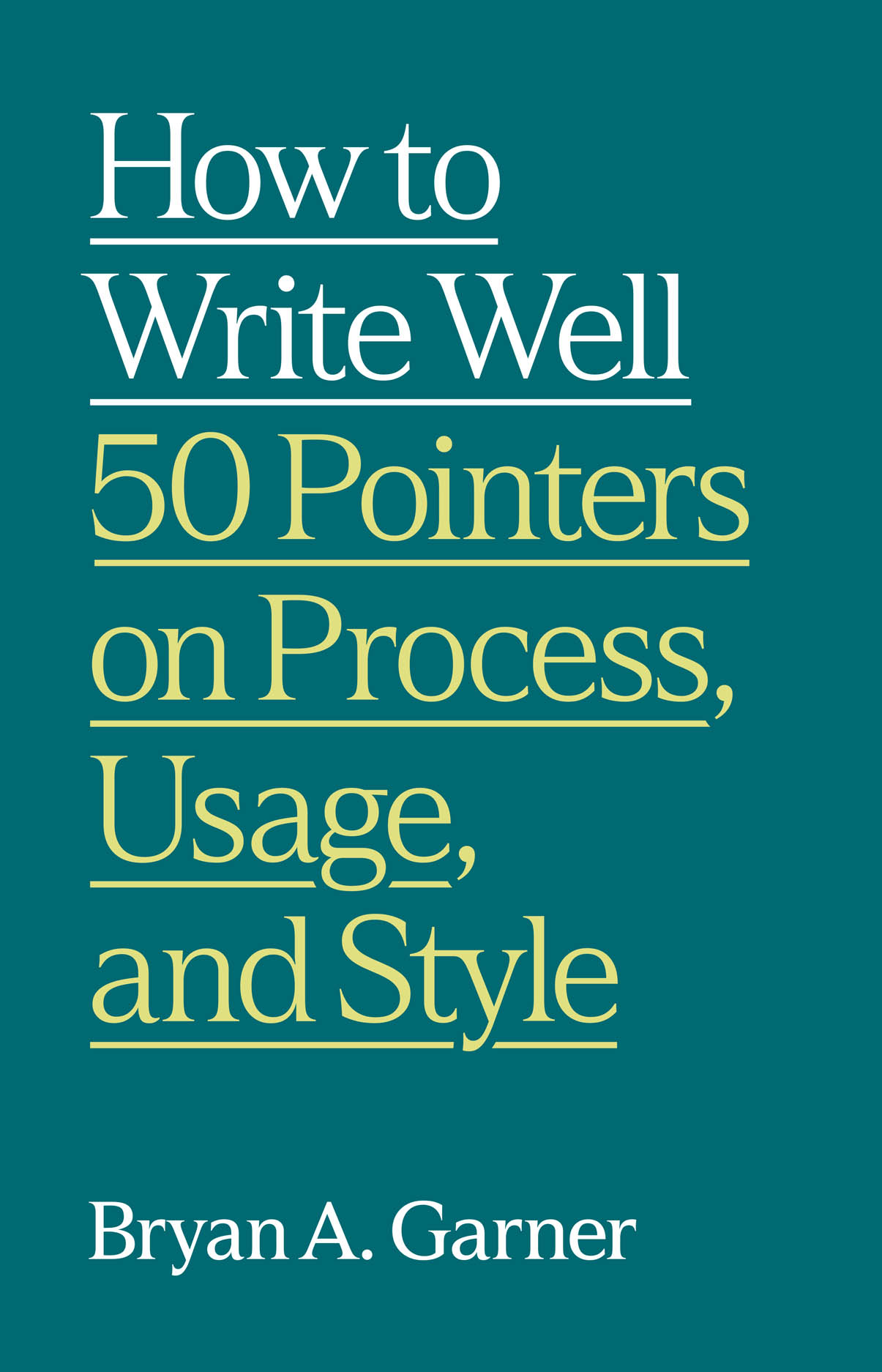
How to Write Well
50 Pointers on Process, Usage, and Style
How to Write Well
50 Pointers on Process, Usage, and Style
Stop worshipping Strunk and White. Start writing well, with 50 tips and techniques from language expert Bryan A. Garner.
For decades, people looking for a concise guide to English-language writing turned to The Elements of Style by William Strunk Jr. and E. B. White. That slim book has been used by everyone from high school and college students to professionals seeking quick advice on usage, grammar, and form. But The Elements of Style hasn’t been updated in more than a quarter century, and it no longer reflects the way good writers work or what they most need to know, especially in the age of generative AI.
How to Write Well: 50 Pointers on Process, Usage, and Style is the modern, evidence-based alternative. Leading language and writing expert Bryan A. Gamer distills a lifetime of teaching and research into 50 compact pointers for modern writers seeking to produce clear, accurate, and lively prose. You’ll learn how strong writers think, how they turn ideas into blueprints, and how they draft, revise, and tighten with ruthless selectivity. You’ll also encounter lucid guidance on grammar and punctuation that corrects Strunk & White’s famous blunders, including shaky treatment of passive voice and a fixation on trivia over substance.
How to Write Well presents a start-to-finish method: mindset, habits, process, and the concrete techniques that produce clean, forceful writing. Unlike The Elements of Style, this book doesn’t pretend your draft magically appears on the page. It shows you how to generate ideas, structure them, and build a repeatable process for everything you write—from emails and memos to articles, briefs, and books. And while emphasizing the mind and the voice of the writer, it also offers advice on working intelligently with AI while keeping full editorial control.
If you’re serious about writing, Garner’s How to Write Well is the indispensable style book you need now.
144 pages | 4 1/2 x 7
Chicago Guides to Writing, Editing, and Publishing
Guides, Manuals, and Reference: Guides for College Students, Guides for Graduate Students, Guides for Legal Professionals, Guides for Scholars
Reviews

Table of Contents
How to Use This Book
Introduction
Part One: How Writers Think and Work
The Writer’s Mindset
1. Adopt a writerly attitude.
2. Demand specific, well-formed ideas from yourself.
3. Picture your readers and address them directly.
4. Be conversational and sincere, not stiff and stuffy.
5. Cherish simplicity.
The Writer’s Habits and Tools
6. Read professionally edited prose daily. Pay attention to language everywhere.
7. Write every day. Don’t wait for inspiration.
8. Learn the art of ruthless selectivity.
9. Develop a self-teaching, self-critical habit.
10. Build courage to risk clear, committed statements.
11. Create a favorable writing environment.
12. Build your vocabulary with purpose.
13. Keep a usage guide and a style manual within reach—and get familiar with them.
14. Make your research retrievable.
15. If you use AI, frame your prompts well and maintain editorial control.
The Writing Process
16. Brainstorm, plan, draft, revise.
17. Discover what you have to say and then shape it into a blueprint.
18. Before you write in full, reconsider your structure. Remember the “rule of three.”
19. Working from your blueprint, compose as swiftly as you can.
20. Improve what you’ve written before sharing it.
21. Tighten your prose relentlessly. Welcome edits from others.
Part Two: How Strong Prose Looks and Behaves
Guiding the Reader
22. Orient your readers immediately, without cryptic “insider” talk.
23. To persuade the unreceptive reader, address the obvious objections to your position.
24. Keep your promises. Once you announce what you’re doing, carry through.
25. Be concrete, specific, and vivid.
26. Use acronyms and other abbreviations sparingly.
27. Pace your ideas. Word your sentences gracefully.
28. Use interesting wordings, not pedestrian ones.
29. Whenever you can, replace inert verbs with livelier ones.
30. Understand and capitalize on the positions of emphasis, especially beginnings and endings.
31. Shape and link your paragraphs.
32. Avoid thrusting yourself into the foreground.
Core Grammatical Points
33. Forget the martinet’s simplistic rules.
34. Prefer But to However at the beginning of a sentence, and don’t put a comma after the But.
35. Don’t fret about split infinitives or sentence-ending prepositions.
36. Place your adverbs carefully.
37. Master subject-verb agreement and pronoun cases.
38. Take care with either and neither.
39. Mind the words that, which, and who.
40. Insist on parallelism.
41. Prefer subordinate clauses to coordinate ones.
Essentials of Punctuation
42. Without dogmatizing about the serial comma, adopt a convention.
43. Avoid extraneous commas.
44. Don’t fuse independent clauses with a comma and don’t break one independent clause with a period.
45. Learn some easy rules for plurals and possessives.
46. Hyphenate your phrasal adjectives but don’t hyphenate most prefixed terms.
47. Use long dashes guiltlessly but not excessively.
Part Three: How to Come into Your Own
Writing for Life
48. Play with simile and metaphor.
49. Have fun when you write.
50. Never stop learning.
Acknowledgments
Index