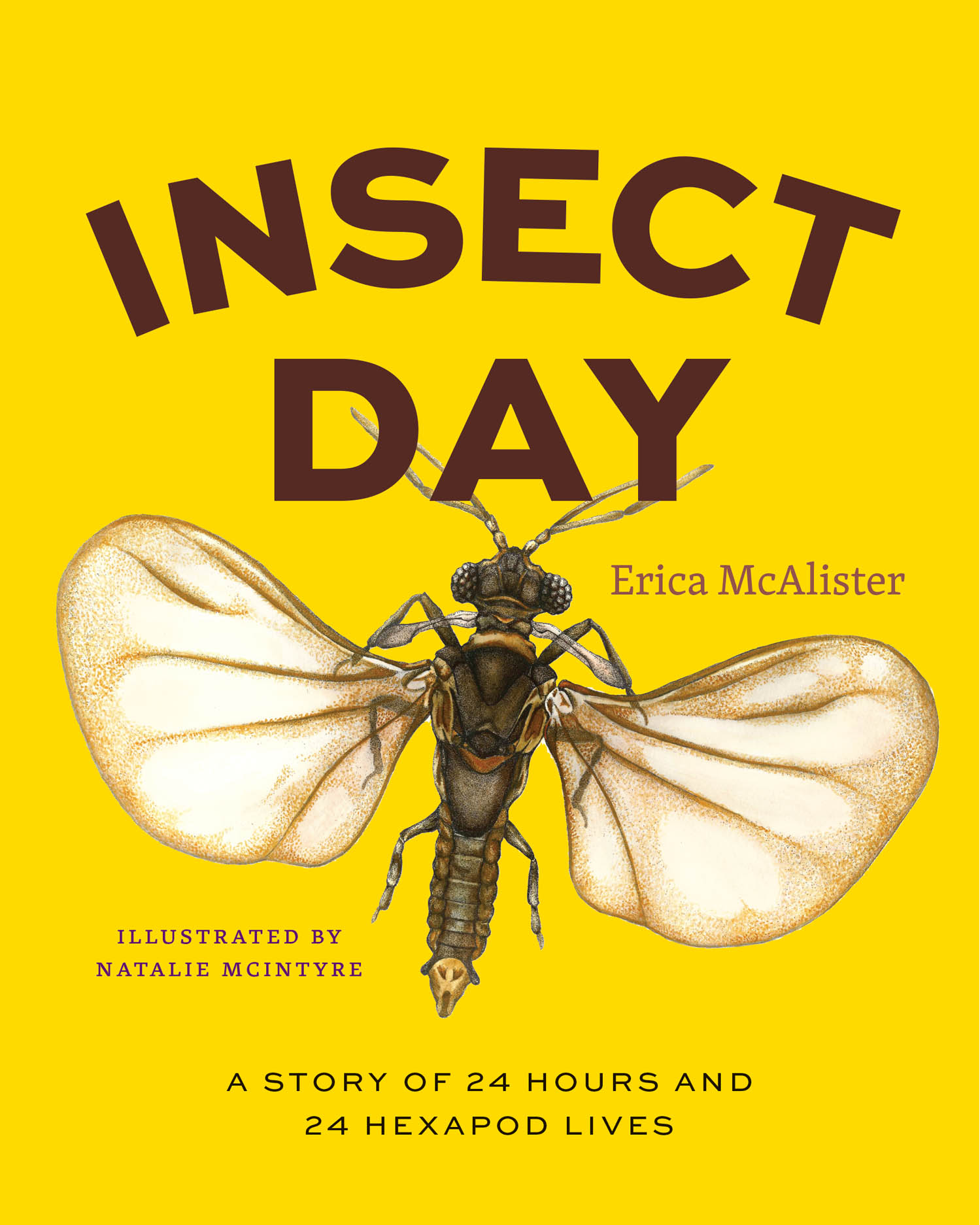
Insect Day
A Story of 24 Hours and 24 Hexapod Lives
Insect Day
A Story of 24 Hours and 24 Hexapod Lives
An hourly guide that follows twenty-four insects as they find food, mates, and safety from predators.
In this short book, celebrated scientist and award-winning author Erica McAlister leads readers on a worldwide field trip in search of insects. Each chapter of Insect Day introduces a single insect during a single hour, highlighting how twenty-four different species spend their time.
Early in our day, we meet a cold Arctic bumblebee, basking among poppy flower petals to warm itself. Even when the world around her is very cold, she keeps remarkably warm simply by vibrating. Near midday, there is enough sunlight for the blue-winged helicopter, a damselfly, to navigate the forests for her prey. When our insect spots a spider web, she looks for its creator—one vicious hunter eyeing up another. The giant damselfly reverses away from the web and then launches into an attack, grabbing onto the spider with her forelegs. If successful (many spiders are dropped), she perches while feasting. And then, like the most fastidious of diners, she cleans off any gossamer threads with a good preen. In the dark, the dung beetle also looks to the sky, using the Milky Way to orient itself as it rolls a ball of dung—a future home for its offspring. And, as our day closes, a tiger moth escapes bat hunters by fighting sound with sound—jamming bats’ sonar with ultrasonic clicking noises.
For each chapter, artist Natalie McIntyre has depicted these insects in stunning illustrations, blending traditional scientific drawing methods with fine art techniques. Working together to narrate and illustrate these unique moments in time, McAlister and McIntyre have created an engaging read that is a perfect way to spend an hour or two—and a true gift for readers, amateur naturalists, and all insect lovers.
Reviews

Table of Contents
Preface
Artist’s Note
Midnight: Mosquito (Africa)
1 AM: Poor Knights Giant Weta (New Zealand)
2 AM: Dung Beetle (Africa)
3 AM: Matsumura’s Delicate Lacewing (Asia)
4 AM: Orange-Striped Stonefly (Great Britain)
5 AM: Great Dobsonfly (Worldwide)
6 AM: Twisted-Wing Parasite (North America)
7 AM: Arctic Bumblebee (Arctic Circle)
8 AM: Urania Swallowtail Moth (Americas)
9 AM: Tea Thrips (Asia)
10 AM: Zebra Longwing Butterfly (Americas)
11 AM: Yellow-Legged Saddle Casemaker (Northern Eurasia)
Noon: Noon Fly (Asia, Europe, and North Africa)
1 PM: Giant Willow Aphid (East Asia, Introduced Worldwide)
2 PM: Blue-Winged Helicopter (Americas)
3 PM: Red-and-Black Cocktail Ant (Africa)
4 PM: West Wind Gladiator Bug (Africa)
5 PM: Peruvian Shield Mantis (Americas)
6 PM: Black-Horned Tree Cricket (North America)
7 PM: Harlequin Fly (Europe)
8 PM: Blue Mountains Firefly (Australia)
9 PM: Ferocious Water Bug (North America)
10 PM: Common Earwig (Europe)
11 PM: Grote’s Bertholdia (North America)
Epilogue
Acknowledgments
Further Reading
Index