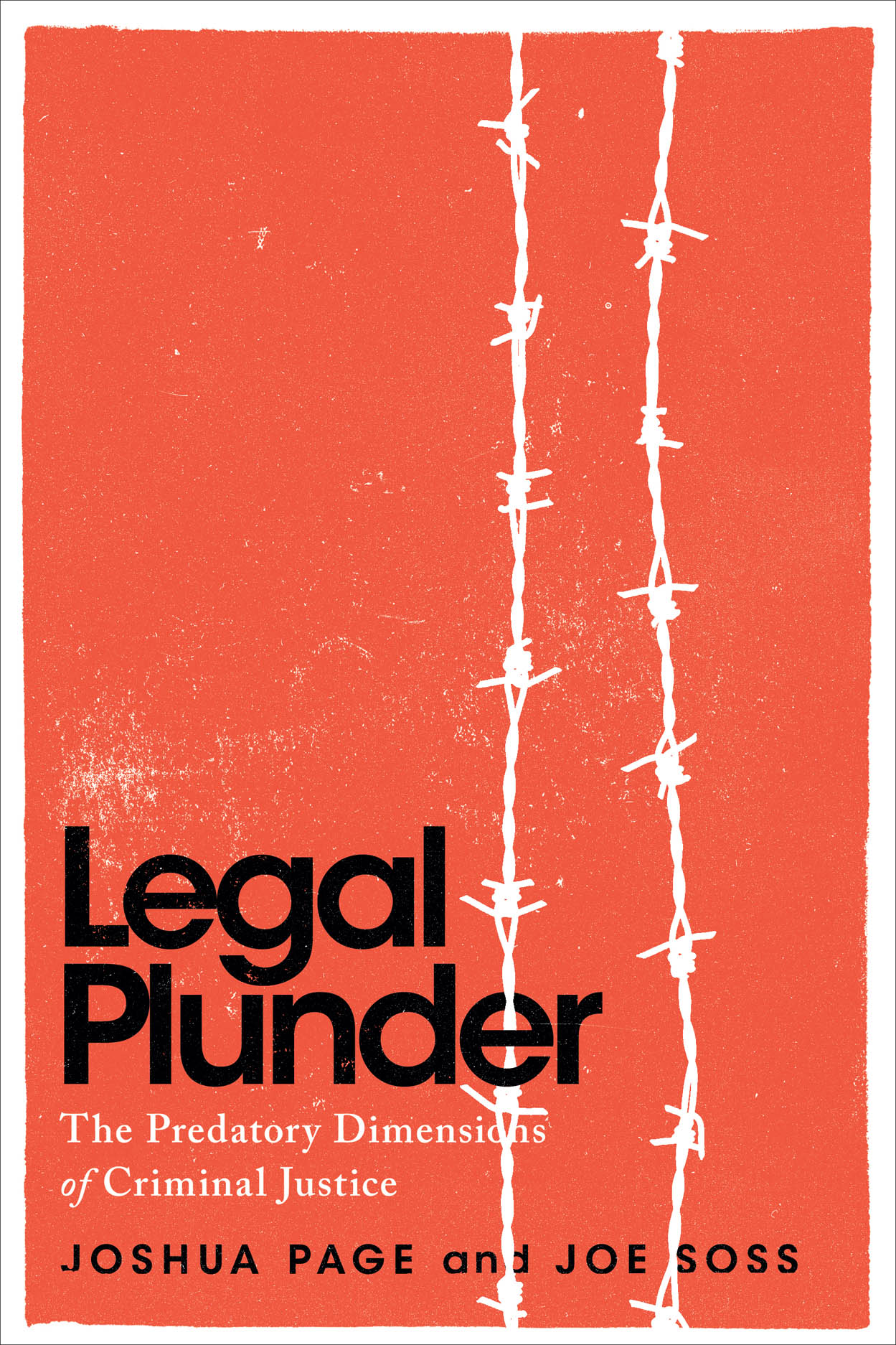
Legal Plunder

The Predatory Dimensions of Criminal Justice

Legal Plunder

The Predatory Dimensions of Criminal Justice

A searing, historically rich account of how US policing and punishment have been retrofitted over the last four decades to extract public and private revenues from America’s poorest and most vulnerable communities.

Alongside the rise of mass incarceration, a second profound and equally disturbing development has transpired. Since the 1980s, US policing and punishment have been remade into tools for stripping resources from the nation’s most oppressed communities and turning them into public and private revenues. Legal Plunder analyzes this development’s origins, operations, consequences, and the political struggles that it has created.

Drawing on historical and contemporary evidence, including original ethnographic research, Joshua Page and Joe Soss examine the predatory dimensions of criminal legal governance to show how practices that criminalize, police, and punish have been retrofitted to siphon resources from subordinated groups, subsidize governments, and generate corporate profits. As tax burdens have declined for the affluent, this financial extraction—now a core function of the country’s sprawling criminal legal apparatus—further compounds race, class, and gender inequalities and injustices. Legal Plunder shows that we can no longer afford to overlook legal plunder or the efforts to dismantle it.

Reviews

"A fascinating exploration of predation in the criminal justice system and its impact on marginalized communities."

Library Journal

“Legal Plunder is the culmination of decades of painstaking research by Joshua Page and Joe Soss, both individually and collectively, that results in a comprehensive rendering of the exploitative nature of the criminal legal system. . ..Placing well-known scholarship on legal and carceral systems in dialogue, Legal Plunder offers a theoretical and substantive framework for discussing the creation, maintenance, and serpentine nature of these systems, as well as their often devastating and harmful effects. . ..Legal Plunder offers a fantastic primer for thinking critically about social science research and its resonance outside of the academy.”

Theoretical Criminology

“In Legal Plunder, Page and Soss bring to light a more insidious part of the U.S. criminal justice system that is often hidden from public view: financial predation…Legal Plunder is a rigorously researched book, with Page and Soss drawing on a blend of academic scholarship, policy developments, and documented cases of predation to substantiate their central claims and illustrate how criminal legal institutions function as sites of financial extraction. Crucially, racial and gendered effects are central to the authors’ arguments. They consistently remind the reader that racial and ethnic minorities, particularly those in poor communities, are disproportionately targeted by these practices.”

Criminal Justice Review

“Family and friends of prisoners are familiar with the high charges for institutional telephone and video calls and commissary services. These are visible indicators of the vast changes that have occurred since the 1980s in the exploitive practices of the criminal justice system. Page and Soss brilliantly and holistically analyze these developments forthe first time. In addition to phone and commissary scams, the authors parse the bail industry, government forfeiture impostures, prison private healthcare services, and the appalling record of the prison industry.”

Choice

“While the story of mass incarceration will be familiar to [readers], a concurrent trend in American criminal justice has received far less attention: the rise of criminal-legal predation. Since the 1980s, a complex public-private infrastructure has developed around extracting revenue from criminalized people, their loved ones, and their communities. In their new book, Legal Plunder, Joe Soss and Joshua Page draw on a decade of historical and ethnographic research to illuminate the origins, operations, and implications of this system.”

The Law and Political Economy Project

“Page and Soss have produced a chilling and fact-based portrait of the American criminal justice system. They show us how a predatory system of fees, fines, and brutality has become institutionalized, spreading through cash-strapped state and local governments.”

Frances Fox Piven | Graduate Center of the City University of New York

“For decades, scholars have pondered whether profit-seeking or the politics of punitiveness was the truest explanation for American mass incarceration. Legal Plunder demonstrates with astounding precision the perfect merger of these goals in a system of ruthless resource extraction that can both warehouse people and make them a productive source of wealth. As the authors show, this is a criminal legal system that deserves the alarming metaphor of ‘predation.’”

Jonathan Simon | University of California-Berkeley

“In this thoroughly researched and expertly argued account, Page and Soss describe the vast instruments of race-targeted plunder that convert the needs of vulnerable groups into a means of revenue for corporate and government entities. Shining a light on these relations, Legal Plunder will become one of the most authoritative analyses of the criminal legal system by mapping its predatory dimensions and, thus, revealing why and how predatory governance emerged, trapped whole communities in its operations, and how to build a more just democracy.”

Vesla Mae Weaver | Johns Hopkins University

Table of Contents

Introduction: Legal Plunder
1 Predation in Theory, History, and Practice

Part One: Operations
2 Predatory Uses of Police and Courts
3 Predatory Uses of Custody and Supervision

Part Two: Development
4 Reconstructing Criminal Justice Predation
5 Justifying Criminal Justice Predation

Part Three: Making Bail
6 The Predatory Dimensions of Pretrial Release
7 Regulated Improvisation at the Front Lines
8 The Intersectional Logic of Bail Predation

Part Four: Significance and Struggle
9 What Do Predatory Criminal Legal Practices Do?
10 Political Struggle and the Fight to End Predation

Conclusion: Predation, Inquiry, and Politics

Acknowledgments
Appendix: Methodology and Ethics
Notes
Index

Awards

APSA: APSA-Race, Ethnicity, and Politics Best Book Award
Won

Law and Society Association: Herbert Jacob Book Prize
Won

ASA Crime, Law, and Deviance Section: Ida B. Wells-Barnett Distinguished Book Award
Won

American Political Science Association: Merze Tate - Elinor Ostrom Outstanding Book Award
Won

ASA Inequality, Poverty, and Mobility Section: Outstanding Book Award
Won

Be the first to know

Get the latest updates on new releases, special offers, and media highlights when you subscribe to our email lists!

Sign up here for updates about the Press