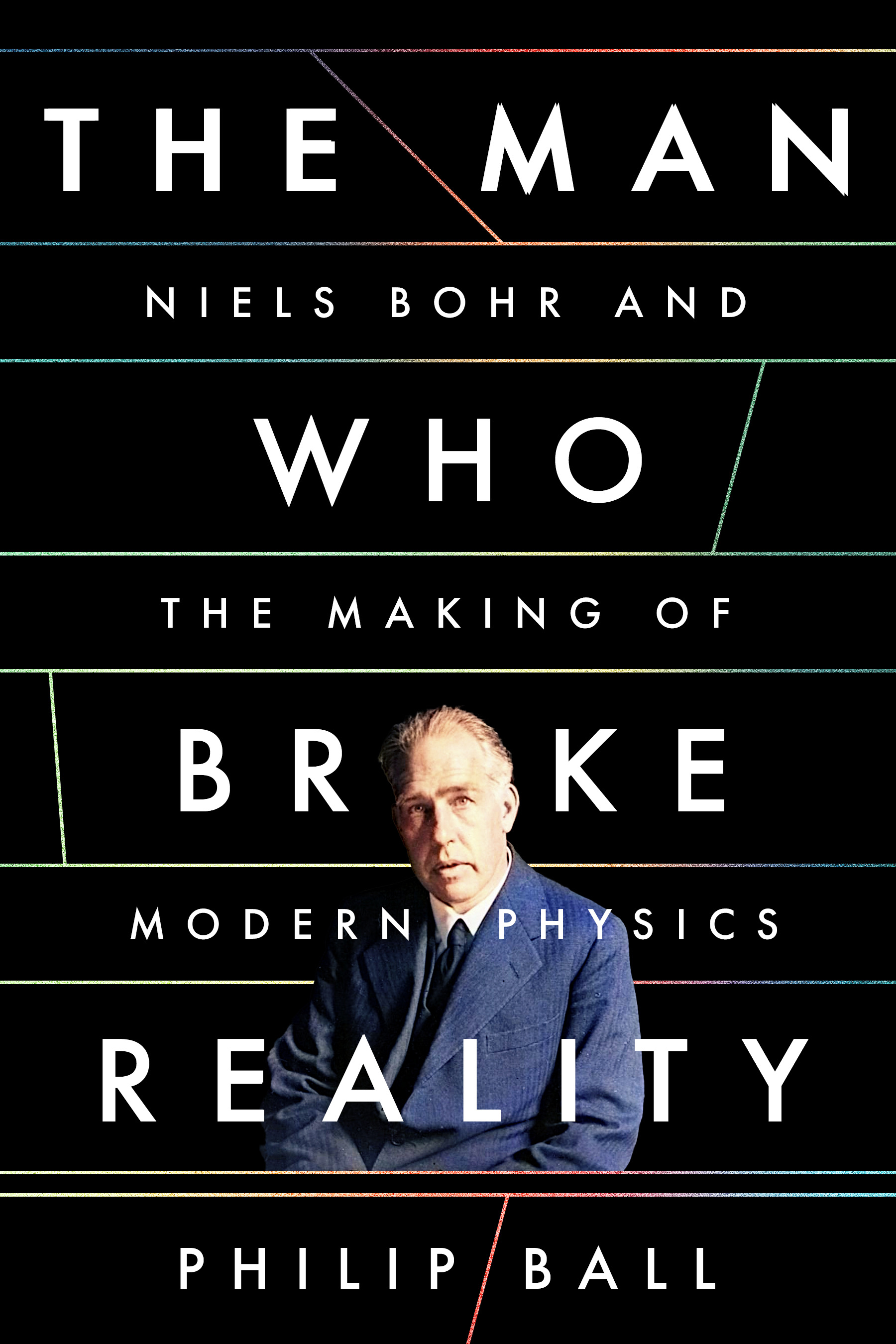
The Man Who Broke Reality
Niels Bohr and the Making of Modern Physics
The Man Who Broke Reality
Niels Bohr and the Making of Modern Physics
From the brilliant Philip Ball, a thrilling biography of Nobel Prize–winning Danish physicist Niels Bohr, the most radical quantum mechanician of all.
In the first half of the twentieth century, the tremendous energy locked up in the nucleus of an atom was discovered and then liberated, bringing both the promise of utopia and the threat of apocalypse. The dawn of the nuclear age is often associated with Albert Einstein, whose iconic equation E = mc2 revealed the staggering energy available from radioactive transformation, or with J. Robert Oppenheimer, who led the project at Los Alamos to build the first nuclear bombs. But the person who arguably did more than any other to shape the Promethean era in which we now live was the Danish physicist Niels Bohr.
In The Man Who Broke Reality, renowned science communicator Philip Ball reveals that it was Bohr who first explained the physics of the nuclear atom, and it was his model of the atom’s dense nucleus that enabled scientists to understand how it could be split apart. Ball also shows how Bohr was the central figure in the development of quantum mechanics, the theory of matter and energy that destabilized centuries of thinking not just about the microscopic nature of the world but about physical reality itself.
Bohr’s story is the story of modern physics and its transformative impact on the world. But The Man Who Broke Reality is not merely an intellectual drama. It chronicles a heroic life lived in turbulent times, across two world wars, the Manhattan Project, and the arms race of the Cold War. And it establishes Bohr as one of the most profound, inventive, and iconoclastic thinkers of the twentieth century.
512 pages | 20 halftones | 6 x 9 | © 2026
History: History of Technology
Physical Sciences: History and Philosophy of Physical Sciences, Physics--Popular Books
Reviews

Table of Contents
Introduction: Architect of the Atomic Age
1 The Special One: Growing Up in Copenhagen
2 The Smallest Matter: The Mysteries of the Atom
3 Quantum Jumps: Bohr’s Atom
4 Building on the Past: The Institute
5 The View from Copenhagen: Turning the Quantum into a Theory
6 Tables and Waves: Quantum Mechanics
7 Both This and That: Complementarity
8 Entangled: Arguments with Einstein
9 Light and Life: Biology, Society, Philosophy
10 Into the Core: Anatomising the Nucleus
11 Fission: The Dawn of Atomic Energy
12 A Dangerous Occupation: Copenhagen Under the Nazis
13 A Great God: Bohr and the Arms Race
14 The Statesman of Physics: Bohr in the World
Epilogue: A Kind of Science
Acknowledgements
Bibliography
Sources
Notes
Index