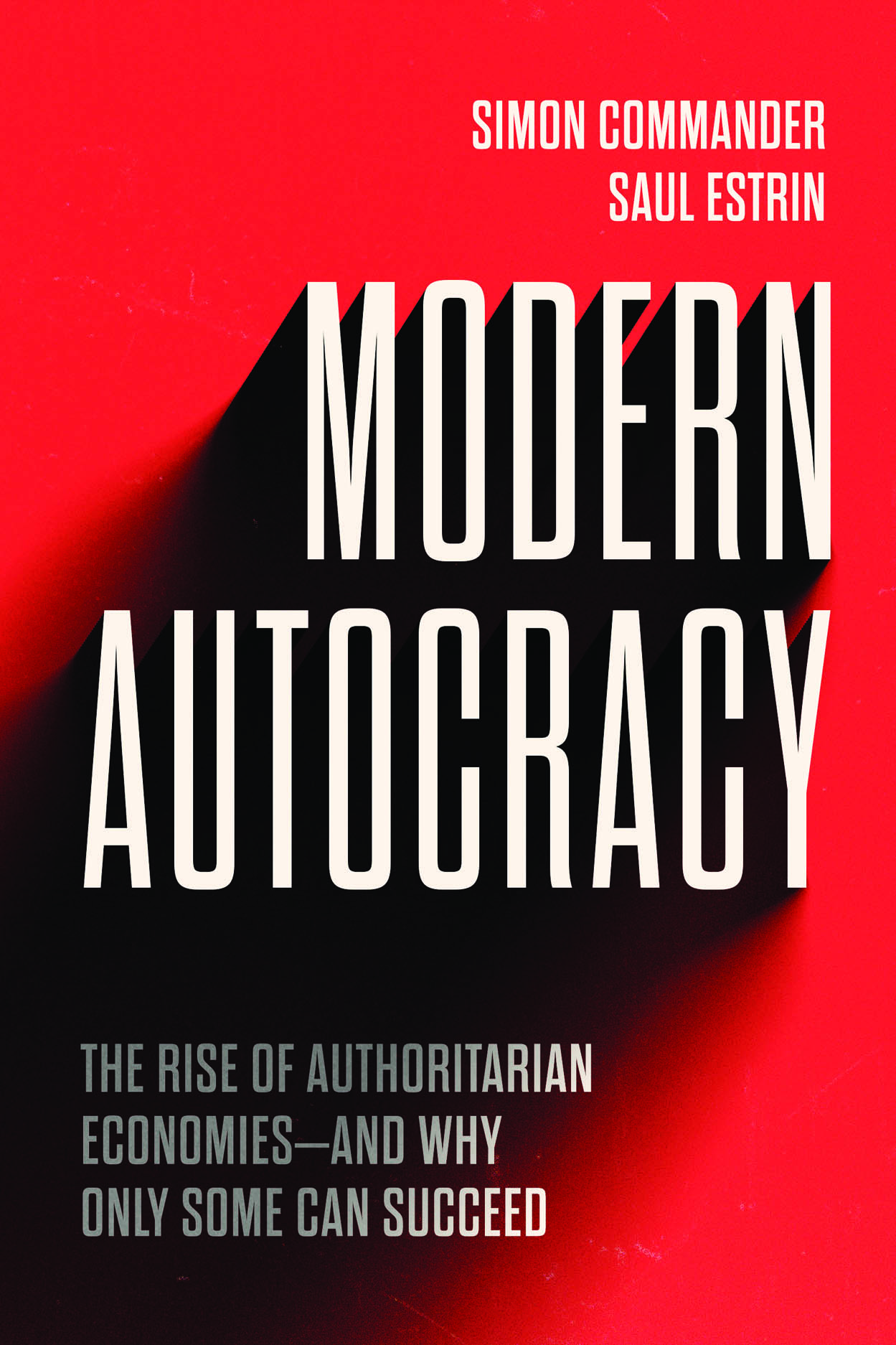
Modern Autocracy
The Rise of Authoritarian Economies—and Why Only Some Can Succeed
Modern Autocracy
The Rise of Authoritarian Economies—and Why Only Some Can Succeed
Strongman governments are back. What becomes of their economies?
Autocracy has once again become a rising force. Today, two thirds of the world’s population live under regimes where electoral democracy is either absent or debased. Moreover, even many functioning democracies are now facing a significant share of their citizens who favor switching to authoritarian rule. But as states return to their old authoritarian ways, what happens to their still-modernized economies?
Simon Commander and Saul Estrin examine the scale of this change—and the unevenly distributed economic consequences that will soon accompany it. Modern Autocracy reveals how authoritarian economies generally perform worse than economies in democratic states, in part because many authoritarian states are centralized around a leader whose economic stewardship facilitates political favor and cronyism. In all, these features, combined with the likelihood of repression, sap economic vitality and stymie competition, innovation, and, ultimately, growth.
The exception, the authors reveal, is that autocracies can perform better when they’re built around an institutional framework rather than simply a leader. That is because they can pursue strategic goals, including innovation; even so, their autocratic foundations open up major vulnerabilities and tensions. Brimming with political relevance, Modern Autocracy is a defining taxonomy of economies and their natures in this century.
352 pages | 48 halftones, 6 line drawings, 8 tables | 6 x 9
Economics and Business: Economics--International and Comparative
Political Science: Diplomacy, Foreign Policy, and International Relations

Table of Contents
Lists of Figures and Tables
Part One: Modern Authoritarianism
1. Authoritarianism and Its Allure
2. The Economics of Authoritarianism
3. The Business of Authoritarianism
4. On Political Systems and Economic Performance
5. The Spoils: Authoritarianism and Inequality
Part Two: The Practice of Authoritarianism
6. Personalized Autocracy
7. Dynastic Autocracy
8. Institutional Autocracy: China
9. Institutional Autocracy: Iran
10. Electoral Autocracy: Hungary
Part Three: How Authoritarian Regimes Evolve
11. Transitions Between Political Systems and Their Durability
Part Four: Dealing with the Big Challenges
12. Do Authoritarian Regimes Innovate?
13. Authoritarian AI
14. Authoritarianism and Climate Change
15. Authoritarianism and Its Future
Acknowledgments
Notes
References
Index