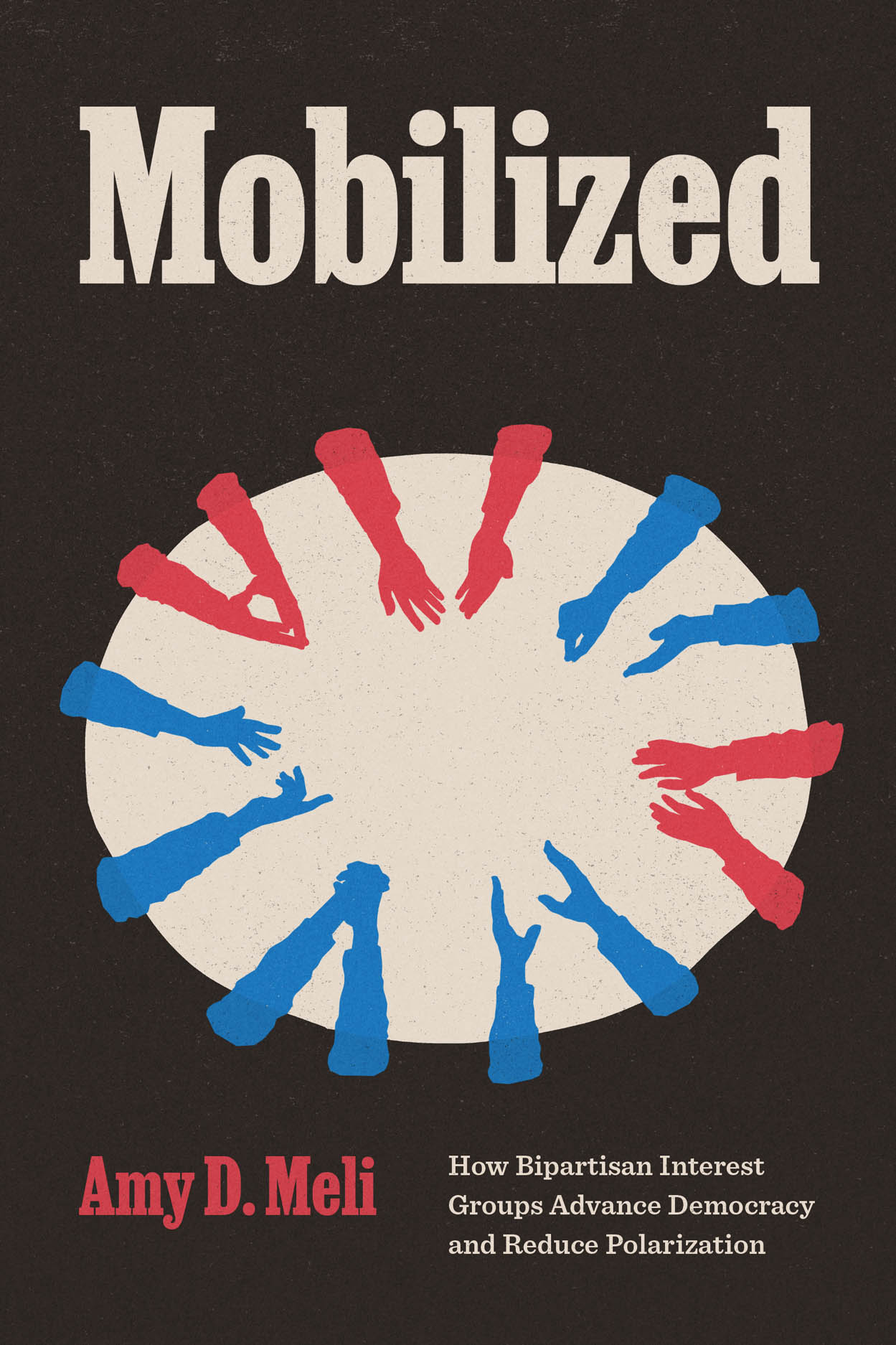
Mobilized
How Bipartisan Interest Groups Advance Democracy and Reduce Polarization
Mobilized
How Bipartisan Interest Groups Advance Democracy and Reduce Polarization
A fresh look at how interest groups mobilize their members and the effects that follow.
Most contemporary accounts of interest group politics emphasize how contemporary interest groups mirror and exacerbate partisan polarization, and understandably so: many of the largest and most visible coalitions do just this. But the term “interest groups” masks considerable variety. Despite what many seem to believe, the majority of interest groups are bipartisan, and, as Amy D. Meli shows, even when groups have a clear affinity with one party over the other, many still choose to pursue a bipartisan strategy.
In Mobilized, Meli develops a method for identifying the partisanship of interest groups and explores how different types of groups communicate with their members. She finds that groups adopting bipartisan policy strategies lobby and mobilize their members differently than those who choose partisan strategies. This, in turn, influences how their members perceive government and politics, leading people involved with these groups to have higher efficacy and lower levels of affective polarization. For decades, we have understood that higher levels of political involvement result in higher levels of polarization, but Meli shows that when involvement is mediated by bipartisan interest groups, affective polarization levels actually go down. Bipartisan groups advocate on issues they care about, and, most of the time, they do so with some support from both parties.
208 pages | 17 halftones, 19 tables | 6 x 9 | © 2027
Chicago Studies in American Politics
Political Science: American Government and Politics, Public Policy

Table of Contents
Introduction: Interest Groups and a Different Kind of Political Behavior
Part I. Interest Groups and Partisanship
Chapter 1. Interest Groups and Policy Strategy
Chapter 2. Interest Groups and Party Proximity
Chapter 3. How Partisanship Drives Interest Group Communication
Part II. How Interest Groups Shape Member Perceptions of Government
Chapter 4. Interest Groups and Perceptions of Government
Chapter 5. How Bipartisan Interest Groups Depolarize Their Members
Chapter 6. Interest Group Involvement and Views About Government Responsiveness
Chapter 7. Where Do We Go from Here?
Acknowledgments
Methodological Appendix
Tables Appendix
Notes
Works Cited
Index