Neither Land nor Water
Planning Through Fringe Ecologies in the Meadowlands (1896–2020)
Neither Land nor Water
Planning Through Fringe Ecologies in the Meadowlands (1896–2020)
An urban and environmental history of the New Jersey Meadowlands, where marsh meets megamall.
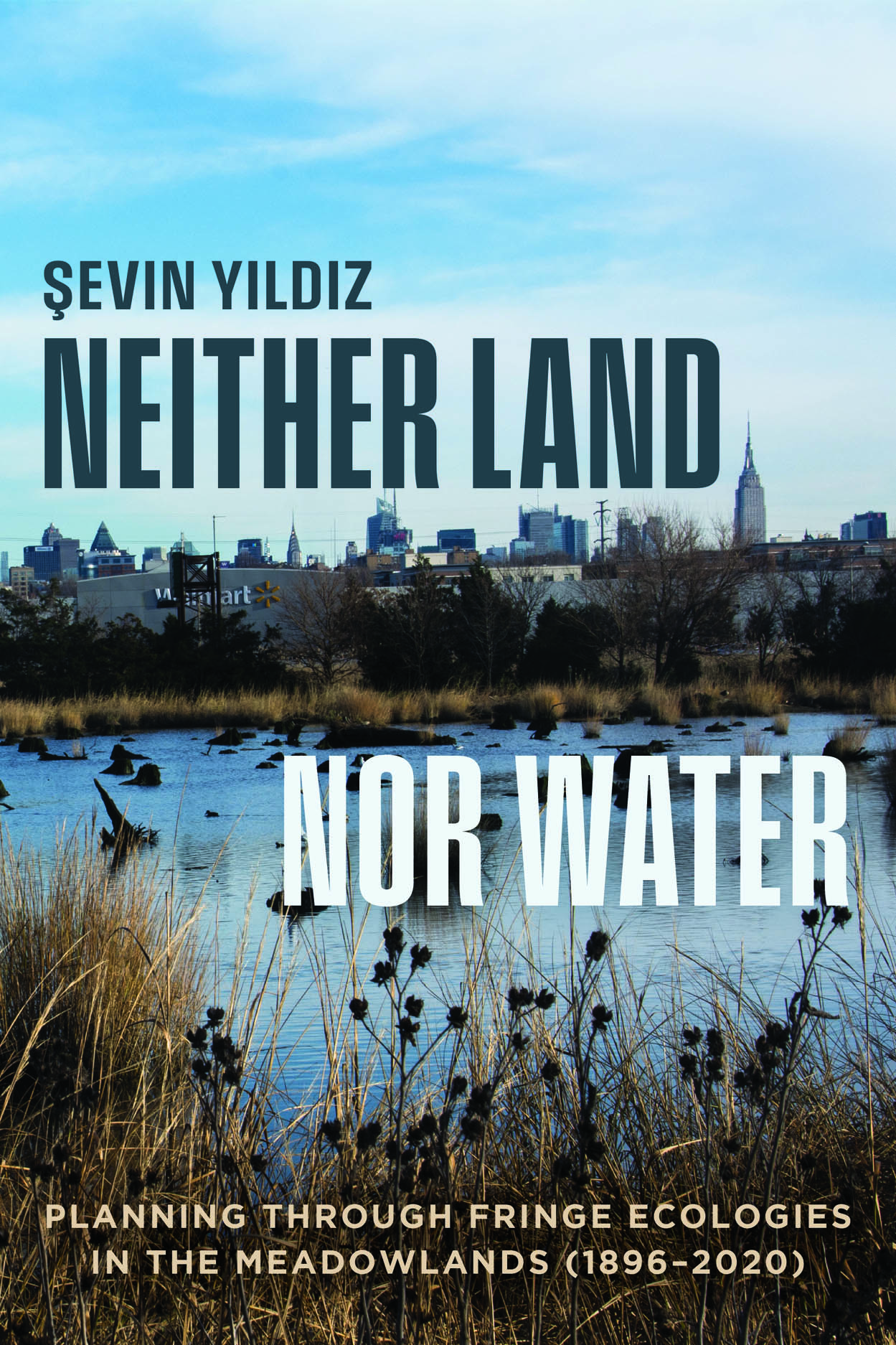
The New Jersey Meadowlands, the vast marshes across the Hudson River from New York City, are a mysterious and complex wetland. Both strange and well-known to the millions of people who traverse the northeast corridor every year, this landscape is not well understood despite its familiarity. Seemingly natural and unnatural, human and nonhuman, the Meadowlands has long been shaped by urban development, industry, infrastructure, and countless dreams.
In Neither Land nor Water, Şevin Yıldız offers a close look at the planners, scientists, developers, politicians, industrialists, and others who have engaged with, dreamed about, or damaged this transitional ecology in different ways over the decades. She traces key periods in the area’s rich histories of urban planning and ecological thought, from the dispossession of the Lenape natives, through the dawn of ecological science, and onto both intensive industrial developments and environmental resistance to them. She examines as well how the Meadowlands exposes the inadequacies of today’s approaches to planning in the face of climate change and how they perhaps offer clues to a better future.
246 pages | 33 halftones | 6 x 9 | © 2026
Geography: Environmental Geography, Urban Geography
History: Environmental History
Reviews

Table of Contents
The Meadowlands Paradox
The Fringe and the Ecotone: Unfolding Fringe Ecologies
Temporality, Scale, and Organization
Chapter 1. The Forces of the Ecotone
The Lenni Lenape Ecotone: Colonial Testing Ground for Enclosure
Making of the Metropolitan Fringe
The Geography of Ambivalence: The Mean High Tide and the Muskrat
A Phantom Boundary and an Urban Valley (1896)
Chapter 2. The Urban Fringe as a Tabula Rasa
Recentralization vs. Regionalism: How the Panama Canal Absorbed the Hackensack Meadows
Regional Plan Association and the Model Town on a “Vast Tract” (1929)
An Industrial Twin for New York City
The Ecotone Resists
The Plan’s Afterlife
Chapter 3. Fringe Ecologies in the Age of Entropy
Managing Entropy and Transforming the Lexicon
A Remedy for Social “Entropy”: Why Did the Meadowlands Come Back to the Planners’ Table?
From Wasteland to Ecosystem: The Conception of an Urban Estuary
Not a Hypothetical Void but Nested Ecosystems: Planning a Regional Breathing Space (1970)
The Urban Fringe on Moratorium
Chapter 4. Fringe and Ecotone: The Comeback
From No Net Loss to Zero Sum
Designed Resiliencies: Navigating the Fringe Ecologies
The Grand Bargain: The New Meadowlands Plan in a No-Zero-Sum Game (2014)
The Ecotone as an Adaptation Monument: Meadowlands National Park Proposal (2017)
Resilience as an Afterthought: The Hackensack Meadowlands Master Plan (2020)
Chapter 5. Fringe Ecologies: “There Are Gaps of Knowledge”
Climate Change Regionalisms
Deepened Ground and Subtracted Plans
Fringe Ecologies Offering Gradients
The Loud Revolution: Values in Planning Through Historicity
Cross-Categorical Hybrids
Acknowledgments
Notes
Bibliography
Index
Author Events
Sevin Yildiz will discuss Neither Land Nor Water at Skidmore, Owings & Merrill
Sevin Yildiz will discuss Neither Land Nor Water at Skidmore, Owings & Merrill. For more information, visit the event site.
Skidmore, Owings & Merrill
224 South Michigan Avenue
Chicago