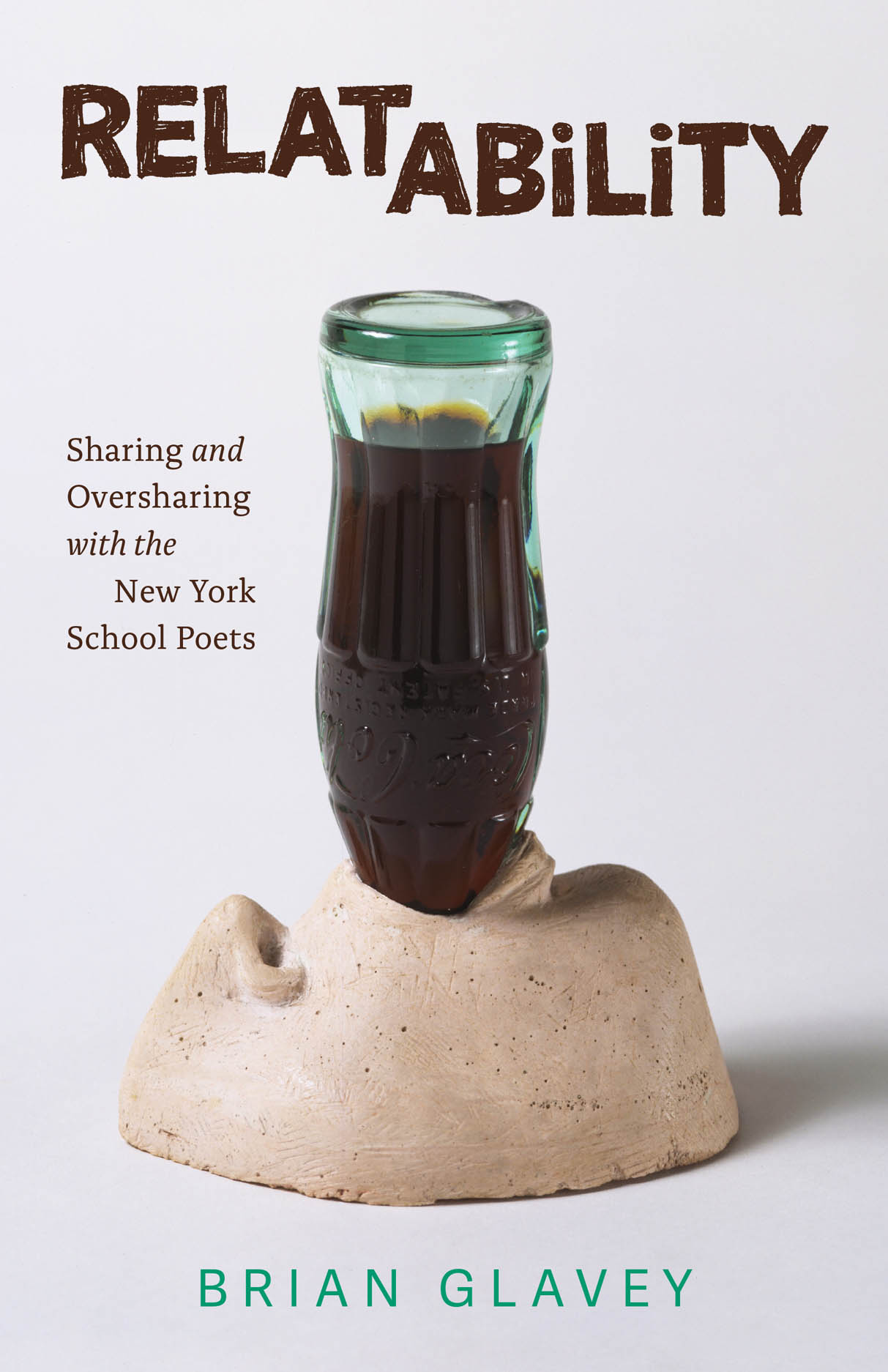
Relatability

Sharing and Oversharing with the New York School Poets

Relatability

Sharing and Oversharing with the New York School Poets

An engaging account of how the New York School poets used art to imagine their queerness as something that might be shared with other people.

How did Frank O’Hara and other New York School poets—a small coterie associated with experimental art and gay culture —become fixtures in today’s culture, quoted on prestige television shows, in teen romances, and at the wedding ceremonies of straight celebrities? How, in other words, did these poets become so relatable? Brian Glavey’s Relatability tells the story of an aesthetic as it traveled from a cluster of mostly queer poets in the middle of the twentieth century to become increasingly central to everyday life in the early twenty-first century. 

That the New York School poets are more relatable now than they were during their own lifetime speaks in part to the growing acceptance of same-sex desire in American culture. But Glavey argues that this transformation also tells the story of a shift in the way that aesthetic experience is understood to work. Moving away from forms of modernist impersonality, O’Hara, John Ashbery, James Schuyler, and Joe Brainard made sociability central to the experience of art and literature. Attempting to share their experience of works of art, they were willing to risk the reader’s judgment that they had, perhaps, overshared. Glavey advances an idea of aesthetic judgment that takes seriously its missed connections as well as its successes. Relatability adds a fresh perspective to current conversations around attachment and affect in literary studies.


240 pages | 3 halftones | 5 1/2 x 8 1/2 | © 2026

Literature and Literary Criticism: General Criticism and Critical Theory

Reviews

“This is a major book by a brilliant critic at the height of his powers. By way of a revelatory argument about the New York School poets and the importance of queer sharing to the aesthetic experiences they offer and promote, Glavey here develops a thrillingly original theory of oversharing and relatability. I know of no book that speaks so insightfully and movingly about how we read, teach, think and feel today.”

Jonathan Flatley, University of Chicago

“In Brian Glavey’s charming and piercing readings, poetry is an aspiration to mutuality as much as it is a representation, and anything like the singularity of a queer poem often flutters fortuitously towards the generality of utopian expanse. A smart and lovely book.”

Anna Kornbluh, University of Illinois Chicago

“The academic world is full of hedgehogs and people with hammers, but Brian Glavey is a friendly fox. I learned a ton from this book and loved the process of learning.”

Stephanie Burt, Harvard University

"This brilliant book provides a crucial new paradigm for understanding the preoccupations of our age, tracing the contemporary compulsion to share, and overshare, back to an unexpected source: the New York School poets, who anticipated the relational logic of our social media age decades before it arrived. Brian Glavey turns ‘relatability’ itself—a concept often mocked or dismissed—into a rigorous, illuminating category of aesthetic experience, offering a bracing revisionary reading of queer theory along the way.  Wonderfully written, witty, and refreshingly personal, with dazzling close readings and provocative insights on every page, this is a major book."

Andrew Epstein, Florida State University

Table of Contents

Introduction, or, Why I’m Telling You About It
1. Relating to Frank O’Hara
2. The Relatability of the Closet
3. Ghosting Jimmy Schuyler
4. On Likability
Conclusion: Alice Notley’s Jacket

Acknowledgments
Notes
Bibliography
Index

Be the first to know

Get the latest updates on new releases, special offers, and media highlights when you subscribe to our email lists!

Sign up here for updates about the Press