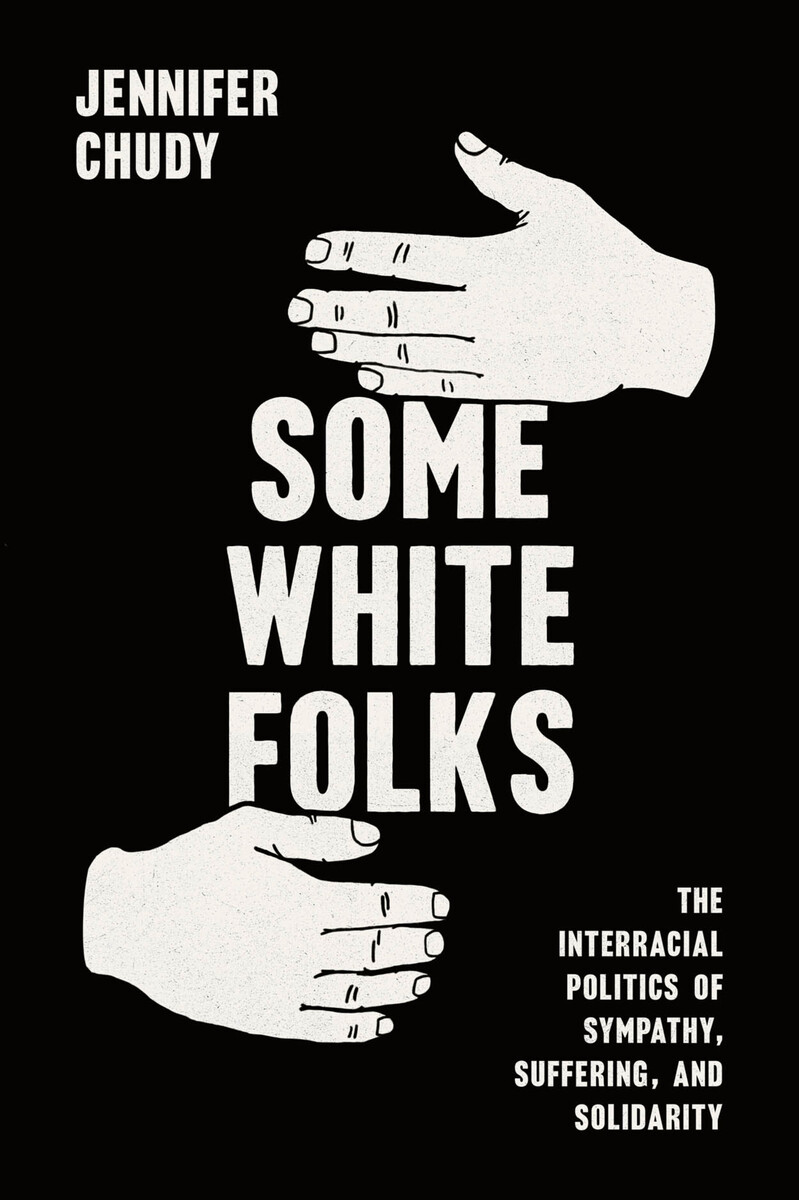
Some White Folks

The Interracial Politics of Sympathy, Suffering, and Solidarity

Some White Folks

The Interracial Politics of Sympathy, Suffering, and Solidarity

A pioneering exploration of the unexamined roots and effect of racial sympathy within American politics.

There is racial inequality in America, and some people are distressed over it while others are not. This is a book about white people who feel that distress. For decades, political scientists have studied the effects of white racial prejudice, but Jennifer Chudy shows that white racial sympathy for Black Americans’ suffering is also a potent force in modern American politics. Grounded in the history of Black-white relations in America, racial sympathy is unique. It is not equivalent to a low level of racial prejudice or sympathy for other marginalized groups. Some White Folks reveals how racial sympathy shapes a significant number of white Americans’ opinions on policy areas ranging from the social welfare state to the criminal justice system. Under certain circumstances, it can also spur action—although effects on political behavior are weaker and less consistent, for reasons Chudy examines.

Drawing on diverse quantitative and qualitative evidence and integrating insights from multiple disciplines, Chudy explores the origins, importance, and complexity of racial sympathy, as well as the practical implications for political and movement leaders. A companion to the rich literature on prejudice, Some White Folks demonstrates the multifaceted role of race in American politics and public opinion.


280 pages | 16 line drawings, 49 tables | 6 x 9 | © 2024

Chicago Studies in American Politics

Political Science: American Government and Politics, Political Behavior and Public Opinion, Race and Politics

Reviews

“Jennifer Chudy’s Some White Folks is a major scholarly achievement that successfully accomplishes several key objectives. First and foremost, the book goes far beyond recent work (including my own) on the often-ignored role of white racial liberalism in US politics to provide the most comprehensive theoretical and quantitative account to date on the prevalence and power of racially sympathetic attitudes in shaping white Americans’ political opinions…The book is outstanding and should be considered a must-read for anyone interested in American politics in general and racial politics in particular.”

Michael Tesler | Perspectives on Politics

“[Chudy’s] lively, engaging prose weaves together evidence from original and publicly available surveys, survey experiments, and interviews with racial justice activists to demonstrate that racial sympathy exists and does not simply rename a known racial attitude, predicts whites’ preferences over redistribution and beliefs about the carceral state, and, under the right conditions, stimulates political participation. Chudy’s innovation with racial sympathy is straightforward but critical: just because a white person scores low on some measure of prejudice does not mean that they care about Black Americans…By expanding our horizons on what count as racial attitudes, Some White Folks is an agenda-setting book.”

Politics, Religion & Ideology

“Theoretically compelling…As with all important books, this one raises new and interesting questions and provides fodder for further research. Some White Folks rightly draws needed attention to the often- neglected role of White racial sympathy in American politics. However, it also invites questions about the relative importance of positive and negative racial attitudes in informing Whites’ engagement with racially inflected issues…Some White Folks offers a fresh perspective on the role of White racial attitudes in American politics by highlighting the overlooked role of racial sympathy.”

Political Science Quarterly

“Some White Folks embarks on a necessary exploration of the intricate landscape of white Americans' racial attitudes. Chudy presents a compelling portrait of the often-overlooked dimension of racial sympathy, offering valuable insights into its origins, effects, and potential for political change. In a time marked by pressing social inequalities, Some White Folks emerges as a much-needed tool to better detect and accurately track when, why, and how distress over the inequity Black folks endure may arise among White Americans.”

Candis Watts Smith | author of "Racial Stasis: The Millennial Generation and the Stagnation of Racial Attitudes in American Politics"

“An important contribution to the voluminous literature on white Americans’ racial attitudes, which until recently had little to say about anti-racism. Some White Folks demonstrates that non-prejudice is not merely the absence of prejudice. Many white Americans abhor racial discrimination and expect government to address it. When events or movements put racial justice on the nation’s agenda, these Americans are willing to take action to bring positive change. A hopeful conclusion, rooted in a compelling empirical analysis.”

Tali Mendelberg | Princeton University

Table of Contents

Chapter 1.       Introduction: An Underexplored Force in American Racial Politics
Chapter 2.       What Is Racial Sympathy?
Chapter 3.       Measuring Racial Sympathy
Chapter 4.       Who Are Racially Sympathetic White People?
Chapter 5.       Public Opinion on Redistributive Policies
Chapter 6.       Public Opinion on the Criminal Legal System
Chapter 7.       Does Sympathy Lead to Action?
Chapter 8.       Action and Perceptions of Efficacy
Chapter 9.       Racial Sympathy in the Twenty-First Century
Acknowledgments
Appendix A. Chapter 3
Appendix B. Chapter 4
Appendix C. Chapter 5
Appendix D. Chapter 7
Appendix E. Chapter 8
Appendix F. Survey Items and Interview Script
Notes
References
Index

Be the first to know

Get the latest updates on new releases, special offers, and media highlights when you subscribe to our email lists!

Sign up here for updates about the Press