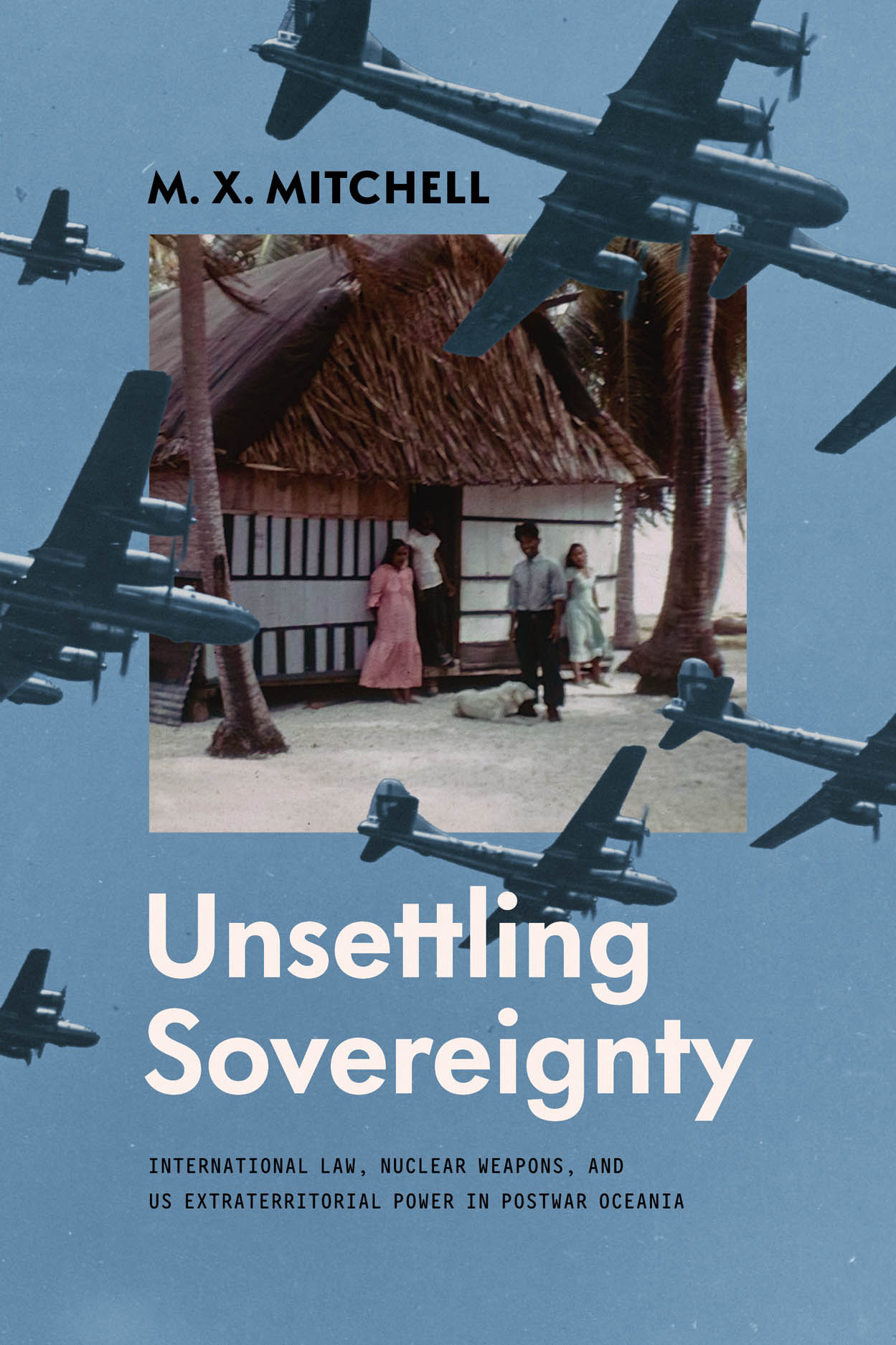
Unsettling Sovereignty
International Law, Nuclear Weapons, and US Extraterritorial Power in Postwar Oceania
Unsettling Sovereignty
International Law, Nuclear Weapons, and US Extraterritorial Power in Postwar Oceania
Marshall Islanders and their ancestral lands and waters played important roles in reshaping the United States’ offshore power, state sovereignty, and the international politics of decolonization.
In the years following World War II, the United States conducted sixty-seven devastating nuclear blasts in the Marshall Islands—yet the archipelago was never a US territory. Working through the United Nations, US diplomats engineered a new, one-of-a-kind extraterritorial status, called strategic trusteeship, to control the Native lands, waters, and peoples of the Marshall, Caroline, and Northern Mariana Islands. Strategic trusteeship permitted the US to militarize a vast expanse of Western Oceania. This novel and racialized legal form of international dependency was integral to US nuclear weapons detonations and damage in the region.
In Unsettling Sovereignty, M. X. Mitchell recounts this untold legal history, exploring how nuclear weapons changed claims and practices of sovereignty from the 1940s to the present. US nuclear blasting in the Marshall Islands troubled conventional renderings of state sovereignty under international law. The explosions, disastrous for Marshallese communities and their ancestral atolls, also caused hazardous nuclear fallout, which spread around the globe. Islanders and their allies turned to law, using legal wrangling over blasting and fallout to raise new questions about the location, time, and subjects of state violence in a period of decolonization; the intersections between race, Indigeneity, and wide-scale technogenic harm; and the pitfalls and unfulfilled promises of international law. Mitchell shows that the Marshallese people and their lands and waters were, and remain, central to redefining sovereignty in an era of boundless pollution and climate change.
320 pages | 11 halftones | 6 x 9 | © 2026
History: Environmental History, Military History
Law and Legal Studies: Legal History
Reviews

Table of Contents
Orthography and Place Names
Introduction: Jikin Kweilok (Meeting Ground)
1. The Technic of Military Government
2. The Substance of Sovereignty
3. Sovereignty at Crossroads
4. Legal Fallout
5. Epistemologies of Settlement
6. The Judicial Container
7. A Semblance of Sovereignty
8. The Environment of Decolonization
9. Residual Sovereignty
Epilogue: Fluid Sovereignty
Acknowledgments
List of Archival Collections
Notes
Index