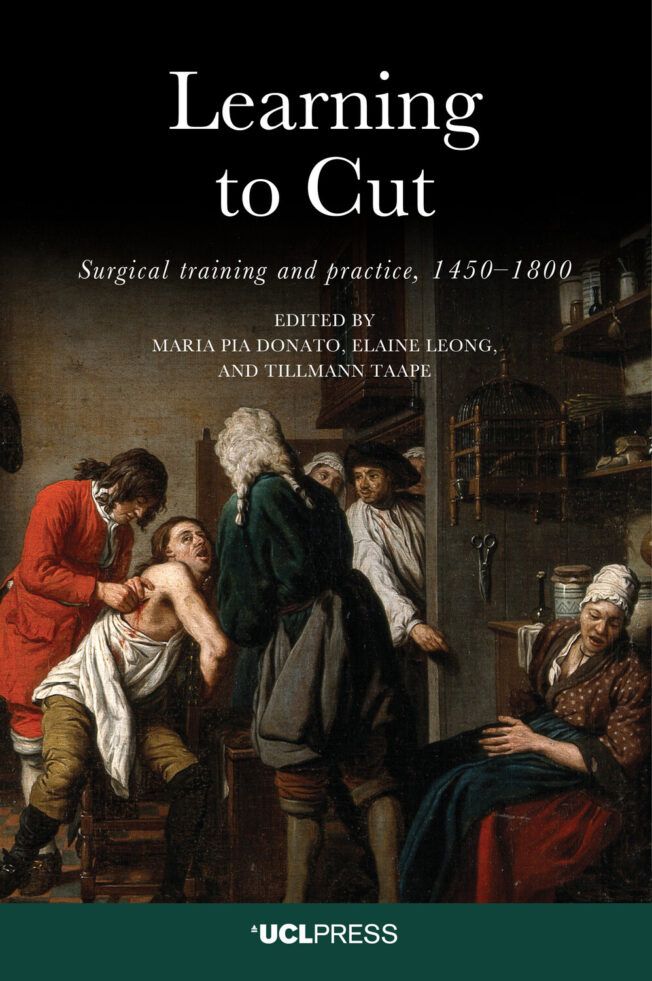
The first-ever volume to offer a broader European narrative on surgical training and education in the early modern era.
This volume brings together case studies from the French, Italian, German, and English contexts to reveal diverse modes of surgical teaching and learning that were shaped by local contexts in early modern towns and cities. The chapters reveal the many spaces where practitioners learned and experienced surgery, shedding new light on the practice of early modern surgery.
348 pages | 28 | 6.14 x 9.21 | © 2026
Opening up the History of Science
History: British and Irish History


Table of Contents
List of contributors
Acknowledgements
1 Introduction: Learning to cut and cutting to learn
Maria Pia Donato, Elaine Leong, and Tillmann Taape
Part I: Diversity of knowledge and practice
2 Learning to cut for the stone: training specialised surgeons in the Holy Roman Empire
Annemarie Kinzelbach
3 Learning to dress wounds: seventeenth-century Italian surgeons and their pharmaceutical competence
Sandra Cavallo
4 Surgical training and practice in sixteenth- and seventeenth-century Germany
Michael Stolberg
5 Leonardo Fioravanti, a (more) learned surgeon: surgical techne and the critique of anatomy
Cynthia Klestinec
Part II: Genealogies of surgical education
6 Learning surgery from medieval manuscripts
Peter Jones
7 ‘The ordinary terms of chest wounds’ or how to become a forensic surgical expert in early modern France. Evidence from a seventeenth-century surgical corporation notebook
Cathy McClive
8 ‘Trained up & now made apt to practise’: vernacular print and surgical training in early modern London
Elaine Leong
9 ‘His body, his honour, his health, and his handwork’: surgical training in printed books and in the city of artisans
Tillmann Taape
Part III: Epistemic modes and strategies of training
10 Learning from disaster: surgical mishaps and pedagogy in the age of print
Heidi Hausse
11 Teaching with images: Guglielmo Riva’s surgical pedagogy in seventeenth-century Rome
Silvia De Renzi
12 Entangled sites of pedagogy: André Levret’s Parisian midwifery course
Scottie Hale Buehler
13 ‘Proficient in all things surgical’. Apprentices learning and doing in Italian hospitals, 1670–1770
Maria Pia Donato
Index