Distributed for UCL Press
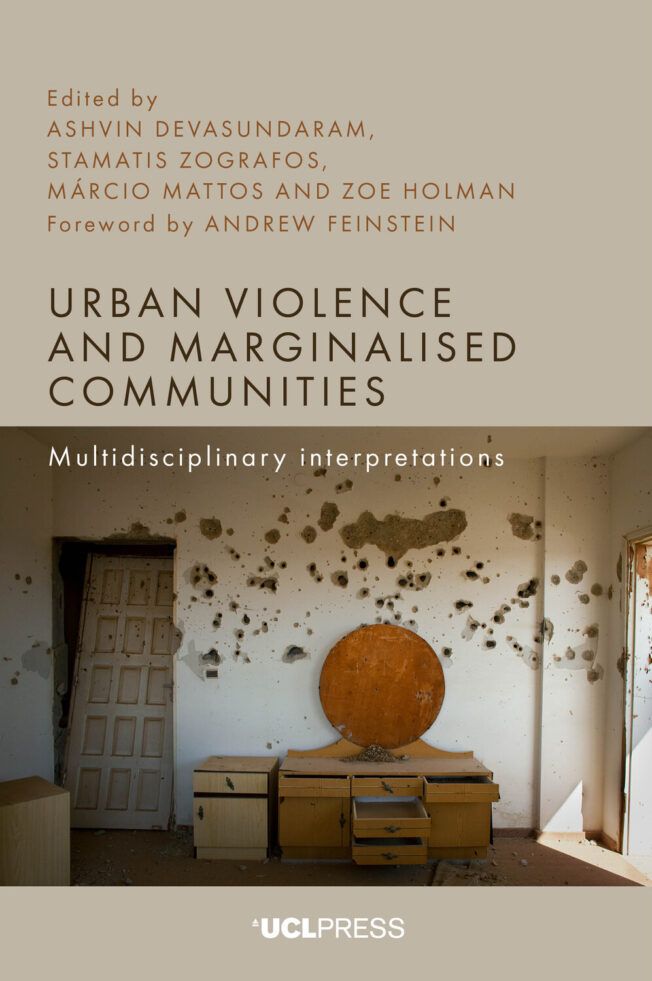
Urban Violence and Marginalised Communities
Multidisciplinary Interpretations
An accessible, informative, and intrepid insight into urban violence through a decolonial and multidisciplinary lens.
Placing peripheralized people at its center, Urban Violence and Marginalised Communities unpacks how urban violence must be understood from multiple points of view, namely through the distinct perspectives of powerholders, decision-makers, law enforcers, urban planners, creative artists, and particularly from the lived standpoint of less empowered communities. Combining social science approaches with explorations in film, media, and the performing arts, the volume challenges conventional, stereotypical, and reductive definitions and conceptions of urban violence by placing local marginalized communities at the forefront of a multilogue and embracing inclusive, innovative, and unconventional analytical and practical approaches and frameworks. A diverse cohort of contributors offers policy-focused counternarratives and potential solutions to systematized forms of overt, covert, and hybrid forms of urban violence(s).
466 pages | 58 | 6.14 x 9.21 | © 2026
Political Science: Urban Politics
Sociology: Urban and Rural Sociology


Table of Contents
List of contributors
Acknowledgements
Foreword by Andrew Feinstein
Introduction
Part I: Multipolar interpretations of migration, marginalised communities and urban violence
1 Embodied violence and passions of resilience: tracing the residues of structural violence in immigrant oral histories
Samuel Finesurrey, Thierno Diallo, Sadaf Majeed, Samantha Ruiz-Correa, Bashir Juwara and Michelle Fine, with Shaday Barrett, Tigida Fadiga, Samantha Hernandez and Holliday Senquiz
2 Asylum seekers’ struggles and forms of violence on the Greek border island of Chios (2015-2016)
Ioulia Mermigka, Nikos Souzas and Jojo Hekate Diakoumakou
3 War, cities and migration-driven diversity: unravelling a complex relationship
Nick Dines
4 African soundtracks in Brazil: race, music and migration
Rose Satiko Gitirana Hikiji and Jasper Chalcraft
Part II: Policing, law and order among marginalised urban demographics
5 Unveiling the lens: exploring motivations behind body-worn camera implementation among police leaders in Brazil
Márcio Júlio da Silva Mattos
6 The fragile governance of security in Brazil
Arthur Trindade Maranhão Costa
7 ‘The police do not keep me safe’: using participatory action research to study the harms of policing and counter their epistemic power
Brett G. Stoudt, Micaela Linder and Joshua G. Adler
8 Femicide at a Croydon bus stop: ‘knife crime’ as category error
Adrian Howe
Part III: Violent cities: multimodal appraisals of the built environment
9 Ledbury Estate: haunting tales of fire and precarity
Rosa Woolf Ainley and Stamatis Zografos
10 ‘Until we take the square’: urban violence and the erasure of difference, from the marginalised periphery towards a touristified, neoliberal Athens
Ioanna Manoussaki-Adamopoulou and Zoe Holman
11 Invisible barriers: the impact of urban development on violence in Maré, Rio de Janeiro
Bruna Ferreira Montuori, Henrique Gomes Silva and Shyrlei Rosendo dos Santos
12 Locating violence within the coloniality of planning and housing. a view across two contexts of displacement in Myanmar and Italy
*Giovanna Astolfo *
13 Navigating the maze of urban violence and housing policy failures: the case of Alexandra and Soweto in post-apartheid South Africa
Mokgaetsi Florence Koenaite and Pheladi Pearl Makena
Part IV: Framing urban violence and marginal communities: film, media and performing arts
14 The covering not the coverage: challenging media collusion in UK state killings
Ken Fero
15 Dreams and dreamlike realities in childhood: (post) memory, fantasy and fear across local, global and cinematic narratives of violence
Mahenderpal Sorya
16 Building the Barricades: violence, mental health, culture and resilience in the favela complex of Maré, Rio de Janeiro
Eliana Sousa Silva and Paul Heritage
17 Coming out across cultures: mapping male mental health in transglobal films
Ashvin Immanuel Devasundaram and Dinesh Bhugra
18 Framing transgenderism: violent otherings of transgender people in urban Kashmir
Toyeba Mushtaq and Aaliya Ahmed
Epilogue: a conversation between Aline Batarseh (Executive Director of Visualizing Palestine) and the editors.
Index